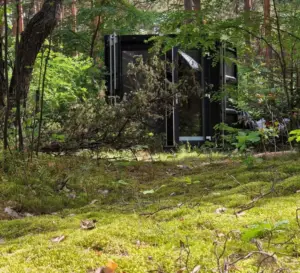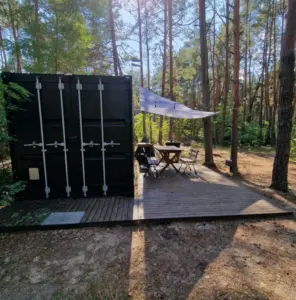


Container construction is gaining popularity as a quick and durable alternative to traditional vacation homes. However, placing a shipping container on a plot of land—especially one designated as forest land—involves a number of formalities. Contrary to popular belief, the absence of a foundation does not exempt the developer from complying with building codes and regulations governing the protection of forest land.
Below, we present a detailed analysis of the investment process based on a real-life case study.
1. Planning Basis: Zoning Regulations (WZ)
If there is no Local Land Use Plan (MPZP) in effect for a given area, the first step is to obtain a decision on the Development Conditions.
Continuity of Decisions: A WZ decision is tied to the property, not to a specific person. If the previous owner obtained a WZ, the new buyer can apply to have it transferred to their name. This saves a tremendous amount of time.
Good-neighbor principle: A building permit may be granted if the adjacent lots are already developed in a similar manner (e.g., existing low-density vacation homes).
2. Exclusion from forestry production—an absolute requirement
This is the most difficult stage for forest plot owners. Many people mistakenly assume that building a structure up to35 square meters (under the so-called “notification” procedure) allows them to avoid contacting the State Forests.
Note: Without a final decision to exclude the land from forestry production, the County Office will not grant permission to build a house. Failure to provide this document will result in the office automatically objecting to the building permit application.
The procedure at the Regional Directorate of State Forests (RDLP) is much more rigorous than at the County Office:
Survey Map: A professional map is required for design purposes (costing several hundred zlotys), on which we mark the area to be excluded (building outline, driveways, terraces). We also attach a land use breakdown to the application, precisely indicating which portion of the area is designated for specific purposes.
Fees and Deposits: The exemption requires payment of a fee for the premature harvesting of the forest stand. A payment of several thousand zlotys is often required, which may be refunded upon completion of the project, although it is replaced by small annual fees.
3. Submission of a construction application to the County Office
Only after the decision to “clear” part of the land has been made can the building permit process begin. In the case of a summer cottage, the procedure can be carried out at a relatively low cost:
Consultation map: It can be downloaded from the county map portal (ePODGiK) for approximately 12 zł.
Development Plan: On the map, mark (to scale) the location of the container, the septic tank (up to10 m³), and the utility connections.
ePUAP: The application, along with drawings and a description of the facility, can be submitted electronically. The county office has 21 days to file an objection (so-called “tacit approval”).
4. Legal Status of a Container: Building or Movable Property?
Under Polish law, a shipping container connected to utilities and used for recreational purposes is treated as a building. The fact that it lacks solid foundations is irrelevant to the regulatory authorities.
Risk | Consistency |
Unauthorized Construction | A fine and corrective proceedings before the Building Authority. |
No deforestation | Heavy financial penalties imposed by the State Forests. |
Demolition Order | In the case of a container, this is easy to do (transporting it to another location), which is the only consolation in the event of a legal dispute. |
Summary
Placing a shipping container on a forested lot is a two-step process. It’s important to follow the correct order: first, the Building Permit Conditions; then, the exclusion from forest production; and finally, the notification to the County Office. Only by following this process can you ensure that your forest property will be fully legal and safe.